How to breathe when running: nose, mouth, rhythm and side stitches
Breathe through your nose and mouth as effort rises, from your belly, at a pace you can talk at. What research says on rhythm, stitches and cold air.

Breathe through your nose and mouth together whenever you need the air: most people switch from the nose to both as the effort climbs. Let your belly, not your chest, do the work, and run at a pace where you can still talk. Matching breaths to steps is worth a try, but no pattern is proven best. Stop or ease off if a stitch hits, and see a doctor if you cough, wheeze or feel your chest tighten during or after runs.
Nose or mouth?
In a 1980 study, 30 healthy adults did exercise that got steadily harder. Twenty began breathing through the nose and switched to nose and mouth together partway through. The switching point varied widely between people and was most closely tied to how hard their breathing felt and how much work nose breathing took.
The nose does warm and humidify incoming air more effectively than the mouth, the American Lung Association says, which is why it advises breathing through the nose in the cold when you can.
Training yourself to breathe only through your nose is another matter. In a 2025 study of 16 recreational runners, eight added four weeks of daily breathing exercises and nose-only breathing in their easy sessions to their training. They gained more breath-hold time at rest than the eight who didn't, but their VO2max, a measure of aerobic fitness, and how long they lasted breathing only through the nose in a running test improved no more. So use your nose on easy runs if it's comfortable, and open your mouth when you need more air.
Breathe from your belly
In belly breathing, also called diaphragmatic breathing, the diaphragm, the large, thin muscle just below your rib cage, draws the air in. Richard Crockett, MD, of Mayo Clinic Health System calls it the most efficient way to breathe, and says chest breathing takes a lot of effort and moves less air. To check yours, he suggests putting one hand on your chest and one on your belly and watching which one rises and falls.
Practice at rest first. Cleveland Clinic suggests lying on your back with your knees bent, one hand on your upper chest and one just below your ribs. Breathe in slowly through your nose so your stomach pushes your lower hand up while the chest hand stays as still as possible, then tighten your stomach muscles and breathe out through pursed lips. Do it for 5 to 10 minutes, three or four times a day. Dr. Crockett suggests moving on to sitting and standing, then walking, and only then running.
Keep expectations modest: a 2022 review of breathing strategies for runners notes that belly breathing has been linked to benefits at rest, but that its effects during exercise are unknown.
Find a rhythm, if it helps
Many runners' breathing falls into step with their feet. A 1983 study in Science recorded human runners locking their breaths to their strides in several patterns, from four strides per breath to one, with two strides per breath appearing to be the favorite. The 2022 review says many elite runners do this without thinking about it, and that training history seems to play a part.
Doing it on purpose has less behind it. The NHS Couch to 5K plan suggests breathing in for 3 steps and out for 2. In a 2023 study of 16 novice to intermediate female runners, breathing was locked to the stride for about 26% of an outdoor run on average without help, and audio cues timed to each runner's steps raised that to about 70%, but the study didn't test whether that helped them. The 2022 review finds limited evidence on learning this as a deliberate strategy, especially below elite level, and says counting steps per breath likely suits only skilled runners. Try a rhythm on an easy run, and drop it if counting becomes a chore.
Let your breathing set the pace
The CDC's talk test: during moderate activity you can talk but not sing, and during vigorous activity you can't say more than a few words without pausing for a breath. In a 2004 study of 16 healthy volunteers, the point where speech first became difficult matched the ventilatory threshold, a marker of effort measured from the breath, almost exactly. If you meant to run easy and can only manage a few words, slow down or walk. Running tips for beginners covers pacing in more detail.
Side stitches
A stitch is a pain most often felt in the middle to upper abdomen along the lower edge of the ribs. A 2015 review by Morton and Callister in Sports Medicine reports that in one survey, 69% of 439 runners had had a stitch in the past year, and that 27% of 848 people at a community fun run, runners and walkers, got one during the event. Young people get them most, and well-trained athletes aren't immune.
The review calls a long-standing explanation, a diaphragm short of blood, unlikely; irritation of the membrane lining the abdomen fits best, though the cause isn't settled. What helps, according to the review:
- Leave time after eating. Avoid large amounts of food and drink for at least 2 hours before a run. In the fun run, runners who ate a large meal 1 to 2 hours before were more likely to get a stitch.
- Skip concentrated drinks. The review advises avoiding hypertonic drinks; in a treadmill study, fruit juice brought on stitches more than flavored water, a sports drink or no drink at all.
- Stop if one hits. Asked what helps, almost 600 people who get stitches named deep breathing most often, then pushing on the spot, stretching and bending forward, though the review calls the reports on stretching and bending forward contradictory. Stopping exercise works best.
Breathing cold air
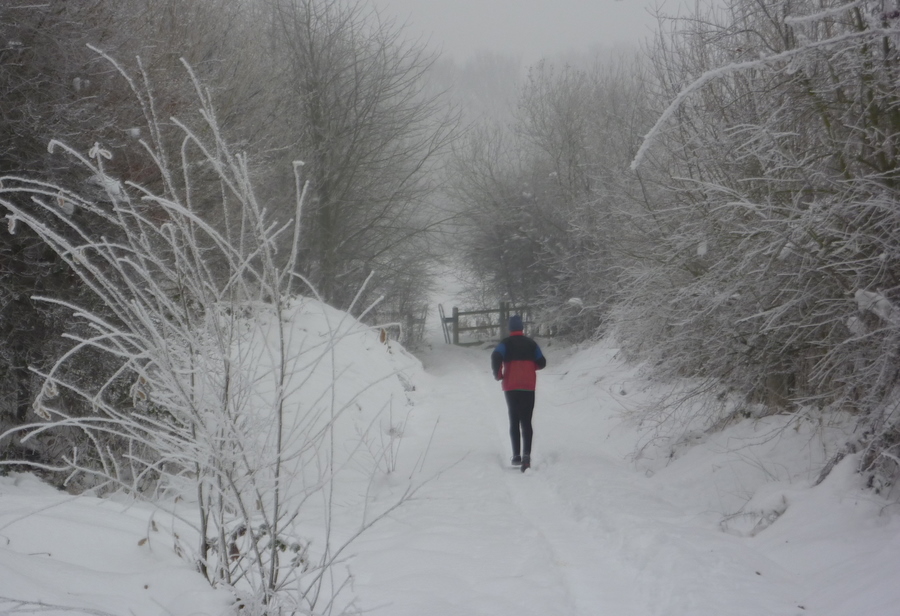
Cold, dry air often irritates the airways, even in healthy lungs, the American Lung Association says. It recommends a layer or scarf over your nose and mouth to warm and humidify the air, and breathing through your nose when possible. For people with exercise-induced asthma, Mayo Clinic also suggests about 15 minutes of warm-up that varies in intensity. For the rest of your kit, see what to wear running in cold weather.
When breathlessness needs a doctor
Exercise-induced asthma, which doctors call exercise-induced bronchoconstriction, narrows the airways during or after exercise. Mayo Clinic lists coughing, wheezing, shortness of breath, chest tightness or pain, fatigue during exercise and poorer than expected performance, usually starting during or soon after exercise. About 90% of people with asthma have it, but people without asthma can get it too. Dry air, cold air, pollution and long stretches of deep breathing, as in distance running, can trigger it.
See a doctor if you have these symptoms, since a few other conditions cause similar ones. Most people with exercise-induced asthma can keep exercising once their symptoms are treated. If you already have asthma and symptoms start during a run, the ALA says to stop and use your quick-relief inhaler. The NHS also advises seeing a doctor if shortness of breath gets worse during your normal activities or when you lie down, or comes with swollen ankles.
Get emergency help right away for:
- Severe difficulty breathing: gasping, choking or being unable to get words out (NHS).
- Chest symptoms: a chest that feels tight or heavy, or pain spreading to your arms, back, neck and jaw (NHS).
- Color or confusion: lips or skin turning very pale, blue or gray, or sudden confusion (NHS).
- Worsening asthma: shortness of breath or wheezing that is quickly getting worse, or no improvement after using a prescription inhaler for asthma attacks (Mayo Clinic).
Frequently asked questions
Should you breathe through your nose or mouth when running?
Both, as you need them. Most people move from nose breathing to nose and mouth as the effort rises. On cold days, the nose warms and humidifies the air better.
Why do I get out of breath so quickly when running?
You may be running faster than your fitness allows for now. If you can only say a few words between breaths, slow down or walk. If breathlessness comes with wheezing, coughing or chest tightness, see a doctor.
How do you get rid of a side stitch?
Stopping works best, a 2015 review says. In one survey, deep breathing and pressing on the spot were what people with stitches tried most. To prevent one, avoid large amounts of food and drink for at least 2 hours before you run, and skip hypertonic drinks such as fruit juice.
Start Running Club
A running plan that builds toward your race one week at a time, with friends who run it too.
Psst is invite-only. Sign up with code RUNCLUB
Scan with your iPhone / Download Psst
Psst is invite-only. Sign up with code RUNCLUB
Sources
- The switching point from nasal to oronasal breathing (Niinimaa, Cole, Mintz and Shephard, Respiration Physiology, 1980)
- The Effects of a Short-Term Supplemental Breathwork Protocol on the Aerobic Performance of Recreational Runners (Wolff, Sherman and Horswill, Sports, 2025)
- Breath Tools: A Synthesis of Evidence-Based Breathing Strategies to Enhance Human Running (Harbour, Stöggl, Schwameder and Finkenzeller, Frontiers in Physiology, 2022)
- Mayo Clinic Q and A: How belly breathing benefits your body, mind (Richard Crockett, MD, Mayo Clinic News Network, 2025)
- Diaphragmatic Breathing (Cleveland Clinic)
- Running and breathing in mammals (Bramble and Carrier, Science, 1983)
- Step-adaptive sound guidance enhances locomotor-respiratory coupling in novice female runners: A proof-of-concept study (Harbour, van Rheden, Schwameder and Finkenzeller, Frontiers in Sports and Active Living, 2023)
- Couch to 5K running plan (NHS)
- How to Measure Physical Activity Intensity (CDC)
- Consistency of the talk test for exercise prescription (Persinger and colleagues, Medicine and Science in Sports and Exercise, 2004)
- Exercise-Related Transient Abdominal Pain (ETAP) (Morton and Callister, Sports Medicine, 2015)
- Tips for Outdoor Exercise in Cold Temperatures (American Lung Association)
- Asthma and Exercise (American Lung Association)
- Exercise-induced asthma: Symptoms and causes (Mayo Clinic)
- Exercise-induced asthma: Diagnosis and treatment (Mayo Clinic)
- Shortness of breath (NHS)