The Saitama workout routine: what it is and how to build up to it
The Saitama workout is 100 push-ups, 100 sit-ups, 100 squats and a 10 km run a day. What it is, whether to try it, and how to build up to it.

The Saitama workout is the training routine from One-Punch Man: 100 push-ups, 100 sit-ups, 100 squats and a 10 km run, every day. The exercises are ordinary, but doing all of it from day one, seven days a week, is far more than most people should start with. The better way is to build up to the numbers over a few months: spread your sets through the day, keep rest days, and start the run as a walk-run.
What the Saitama workout is
Saitama is the hero of One-Punch Man, which the artist ONE started as a webcomic in 2009. Yusuke Murata redrew it as a manga from 2012, and an anime followed in 2015. Saitama can end any fight with a single punch, and he credits that to a daily routine:
- 100 push-ups
- 100 sit-ups
- 100 squats
- a 10 km run
He also ate healthy food and went without air conditioning or heating. In the story, three years of this pushed him to his limits and made him unbeatable.
Should you do all of it from day one?
For most people, no. Here's what the full routine adds up to:
- The run. At a pace of 10 minutes a mile, which the U.S. physical activity guidelines class as vigorous, 10 km takes about an hour. Every day, that's more than seven hours of vigorous running a week. The CDC's baseline for adults is 150 minutes of moderate activity or 75 minutes of vigorous activity a week.
- The strength work. The American College of Sports Medicine (ACSM) recommends resistance exercise for each major muscle group on 2 or 3 days a week, and the same frequency for beginners. Saitama trains the same muscles every day.
- The jump. The U.S. guidelines say the risk of injury to bones, muscles and joints is directly related to the gap between what you usually do and the new level. Going from little exercise to the full routine is a big gap.
Rest is part of getting stronger: an exercise physiologist at the Hospital for Special Surgery (HSS) warns that without rest and recovery you risk overtraining and injury.
Still, the WHO says any amount of activity is better than none, so every set counts while you build up.
If you're starting after a long break, or you have joint problems or a health condition, check with your doctor before you begin.
How to build up to it
Spread your sets through the day
You don't need to do 100 push-ups in one go. The U.S. guidelines say activity in bouts of any length adds to your total, and the CDC notes that you don't have to do it all at once. Ten squats before breakfast, ten at lunch and ten in the evening make 30.
High-repetition work like this builds muscular endurance. For that goal, ACSM suggests light to moderate loads for more than 15 repetitions, with short rests of under 90 seconds. Early on, sets of 5 to 10 are plenty, and they grow as you do.
A week-by-week ramp
Train the three moves on three days a week with a day off in between, such as Monday, Wednesday and Friday, and split each day's number into small sets. If you've been inactive, the U.S. guidelines suggest starting muscle work on just one day a week at a light or moderate effort, then adding days.
| Weeks | Each move, per training day | Push-up version | Squat version |
|---|---|---|---|
| 1 and 2 | 20 | Against a wall | Mini-squat, holding a chair |
| 3 and 4 | 30 | Hands on a kitchen counter | Mini-squat |
| 5 and 6 | 40 | Hands on a kitchen counter | A little deeper |
| 7 and 8 | 50 | Hands on a low, sturdy bench | Full squat |
| 9 and 10 | 60 | Bench or floor | Full squat |
| 11 and 12 | 70 | Floor | Full squat |
| 13 and 14 | 80 | Floor | Full squat |
| 15 and 16 | 90 | Floor | Full squat |
| 17 and 18 | 100 | Floor | Full squat |
Move up a row only when the current one felt manageable on every training day; otherwise, repeat it. Strength and endurance improve as you gradually add sets, repetitions or days, the U.S. guidelines note, so a repeated block is still progress.
Keep the rest days
By week 17 or 18, you'll do the full numbers on three days, run on three others and rest on one. ACSM's guidance stays at 2 to 3 strength days a week for each muscle group, so think twice before making it daily. Warming up and cooling down are also commonly recommended to prevent injuries.
Form for each move
Push-ups
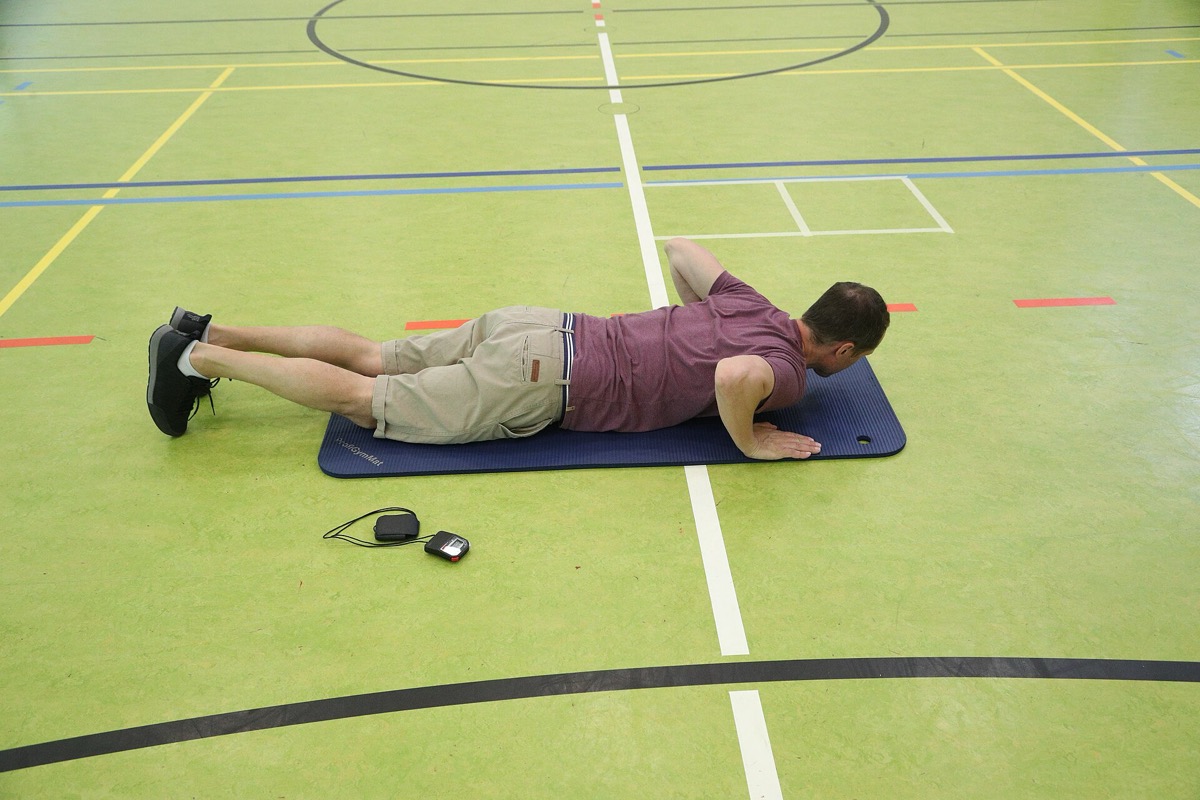
Start against a wall. The NHS version: stand at arm's length from a wall with your hands flat on it at chest level, fingers pointing up. Keep your back straight, bend your arms with your elbows by your sides, then slowly push back. It suggests 3 sets of 5 to 10. Over the weeks, move your hands down to a counter, then a bench, then the floor.
On the floor, the HSS exercise physiologist suggests:
- Hands under your shoulders, slightly wider than shoulder-width apart.
- Think of it as a moving plank, with your core and glutes engaged through the whole movement.
- Elbows at about 45 degrees to your body or closer, pointing back. Letting them flare out puts stress on the shoulders.
Sit-ups, or a plank instead
Harvard Health Publishing says classic sit-ups and crunches have fallen out of favor. Sit-ups push your curved spine against the floor and work the hip flexors, and tight hip flexors can tug on the lower spine and cause lower back discomfort. It calls planks the gold standard for the core:
- Form a straight line from head to heels.
- Don't bend at the hips.
- Don't let your belly drop toward the floor.
Do the sit-ups on days they feel fine and swap in a few plank holds when they bother your lower back, or use planks from the start.
Squats
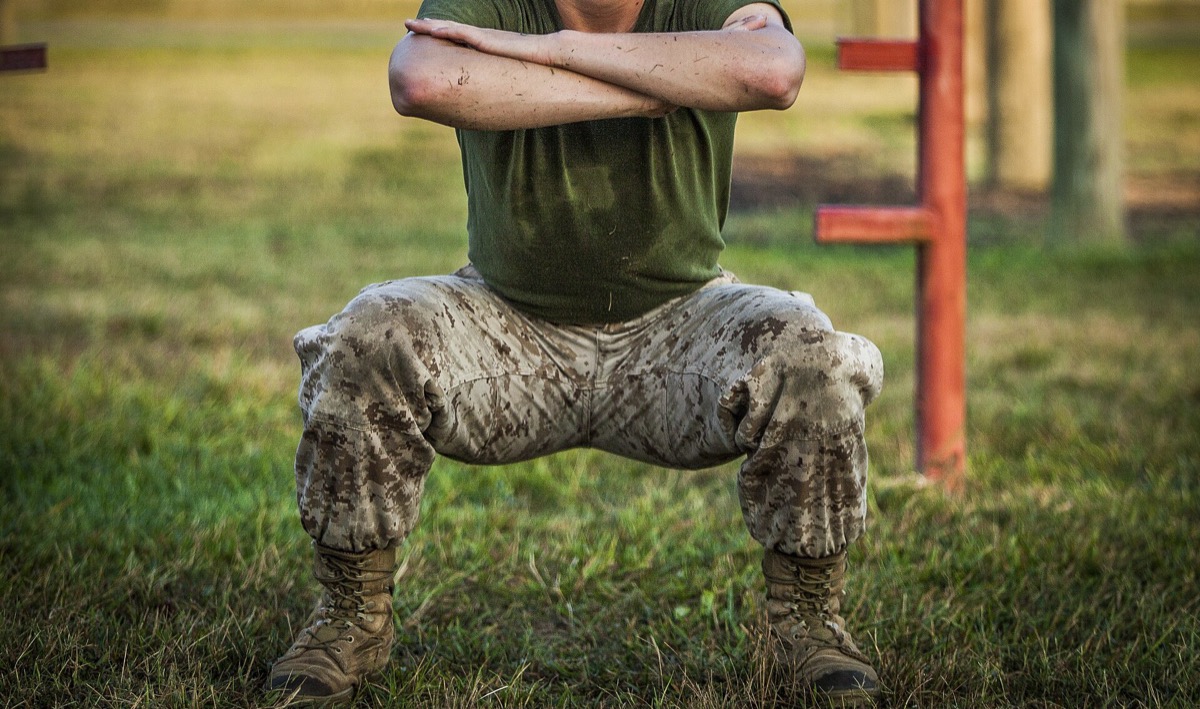
Start with the NHS mini-squat. Rest your hands on the back of a sturdy chair, feet hip-width apart. Slowly bend your knees as far as is comfortable, keeping them facing forwards and your back straight, then come up to standing, squeezing your buttocks. Over the weeks, go deeper while it stays comfortable, and let go of the chair.
The 10 km run: start with walk-run

The run is the part most likely to hurt a beginner. The U.S. guidelines note that walking has a third or less of the injury risk of running, so begin by walking and running in turns. The NHS Couch to 5K plan does exactly that: three runs a week with rest days in between, starting with 1-minute runs followed by 90-second walks, and ending, after 9 weeks or longer, with 30 minutes of running without stopping.
From 5K, add distance slowly. The U.S. guidelines say the size of each week's increase relative to what you already do matters: 20 more minutes is a safer 10% for someone jogging 200 minutes a week than 50% for someone jogging 40. At about 10% a week, going from 5 km to 10 km takes seven to eight weeks, so the run and the strength ramp finish together.
Frequently asked questions
What results can you expect from the Saitama workout?
Slower ones than in the anime. More push-ups and squats per set and an easier run are the realistic results: the U.S. guidelines note that strength and endurance build progressively as you add repetitions, sets or days. If weight loss is your goal, the same guidelines say combining fewer calories with physical activity tends to work better than either one alone.
How long does it take to build up to the full Saitama workout?
With the ramp above, about four months, and longer if you've been inactive. The U.S. guidelines note that it can take months for people with low fitness to reach their activity goals.
Is it safe to do the Saitama workout every day?
It's a lot. ACSM recommends training each major muscle group on 2 to 3 days a week, and the U.S. guidelines warn that doing too much of one kind of activity can cause overuse injuries. A daily 10 km run alone adds up to more than seven hours of vigorous running a week. Rest days and variety lower the risk.
Start Saitama Challenge
Quick sets of push-ups, sit-ups and squats, plus a run. Log them anywhere and climb the power levels to Saitama.
Psst is invite-only. Sign up with code SAITAMA
Scan with your iPhone / Download Psst
Psst is invite-only. Sign up with code SAITAMA
Sources
- Saitama (One-Punch Man)
- One-Punch Man
- Adult Activity: An Overview (CDC)
- Physical activity fact sheet (WHO)
- Physical Activity Guidelines for Americans, 2nd edition (U.S. Department of Health and Human Services)
- ACSM position stand: Quantity and quality of exercise for developing and maintaining fitness in healthy adults (2011)
- ACSM position stand: Progression models in resistance training for healthy adults (2009)
- Strength exercises (NHS)
- Get running with Couch to 5K (NHS)
- Should you start doing push-ups every day? And how to get the proper form (Hospital for Special Surgery)
- Want a stronger core? Skip the sit-ups (Harvard Health Publishing)