How to do more push-ups, from zero: a wall-to-floor routine
Can't do a push-up yet? Test your starting step from wall to floor, train two or three days a week, and move on when 3 sets of 10 come cleanly.
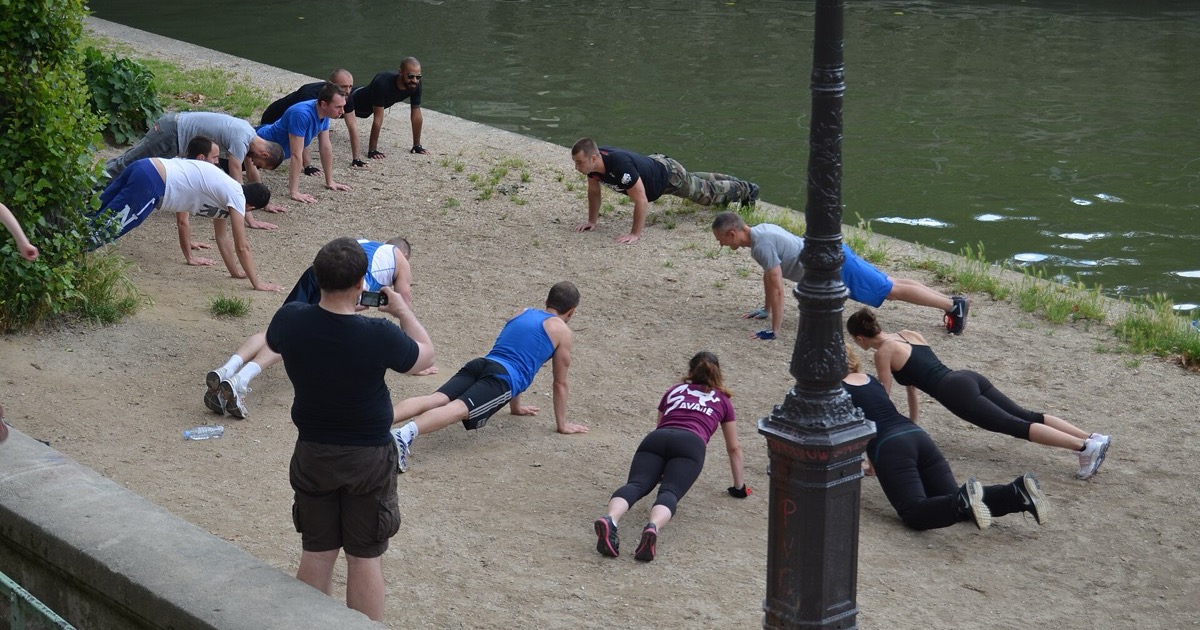
To do more push-ups, start on a version you can do 5 to 10 times with good form: hands on a wall, a counter or a bench, then your knees, then the floor. Train it two or three days a week with a rest day in between, build to 3 sets of 10, then move to the next step. The set, rep and rest numbers below come from the NHS, Harvard Health, Mayo Clinic and the American College of Sports Medicine (ACSM). The starting test, the sample week and the rule for moving on are this guide's suggestions.
Why a ladder works
The lower your hands, the more of your body you push. In a 2010 study of 23 recreationally fit young adults, peak force on a force platform, as a share of body mass, was:
| Version | Share of body mass |
|---|---|
| Hands on a 24-inch box | 41% |
| Knees on the floor | 49% |
| Hands on a 12-inch box | 55% |
| Regular push-up | 64% |
The study didn't test a wall or a counter, which hold your hands higher still.
In a 2025 study, 22 sedentary adults aged 32 to 69 started at the wall and did one slow set of 10 a day, along with three other moves, switching to a harder version once 10 came easily two sessions in a row. After four weeks, nine had progressed to knee push-ups and three, all men, to full push-ups.
The five steps
1. Wall
The NHS version: stand at arm's length from a wall, hands flat at chest level, fingers pointing up. Keep your back straight, bend your arms with your elbows by your sides, close the gap as far as you can, then slowly return. It suggests 3 sets of 5 to 10.
2. Counter
Put your hands on a sturdy counter and walk your feet back. This in-between step is this guide's own. Harvard Health's wall push-up keeps a straight line from head to heel, so do the same here, and Dr. Edward Phillips of Harvard Medical School says changing your body's angle raises or lowers the intensity.
3. Bench or stairs

Use a surface that can't slide, about 24 inches high if you can: in the 2010 study, a 24-inch box was easier than knees and a 12-inch box was harder. Mayo Clinic's stair push-up puts your hands on a step, directly under your shoulders, with your legs in a plank, and says to use the next higher step if you can't lower your body to the stairs. Mayo adds that if you can't stand on one leg for 45 seconds without holding on, some stair exercises may not be safe for you.
4. Knees
Mayo Clinic's modified push-up: on your hands and knees, hands slightly wider than your shoulders, knees comfortably apart, abdominal muscles tight. Slowly bend your elbows until your chin reaches the ground, then slowly return.
5. Floor
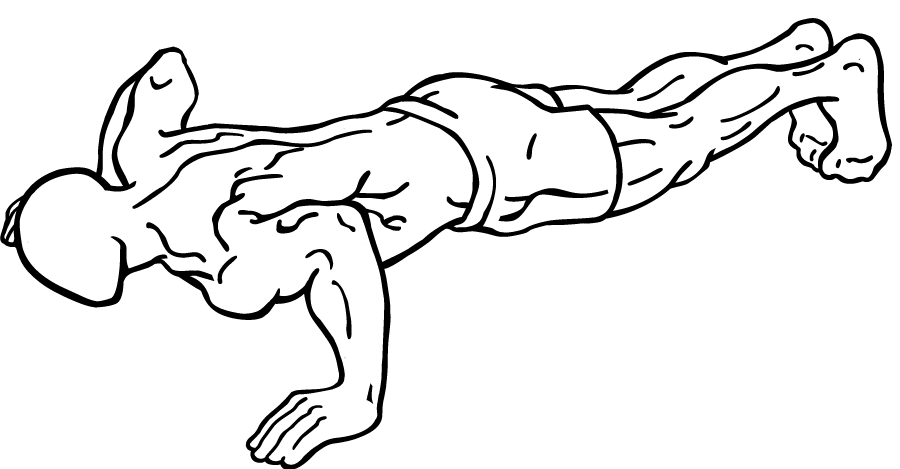
Harvard Health's full push-up starts in a plank, arms extended, palms flat just below shoulder level. Keep your back straight, look down, lower until your elbows reach 90 degrees, and push back up.
Find your starting step
This test is a suggestion, built on the NHS's range of 5 to 10 reps. Let it be your only push-ups that day.
- Warm up. Mayo Clinic suggests a few minutes of brisk walking or another aerobic activity before strength training.
- Start at the wall and do slow reps. Stop at 10, or sooner if your form slips.
- If you reached 10, rest a minute or two and try the next step.
- Stop at the first step where you can't reach 10. If you got at least 5 good reps there, that's your step. If you got fewer, go back one.
If you have a shoulder, wrist or heart concern, check with your doctor before you start.
A week you can repeat
This sample week is a suggestion, with the same numbers on every step.
- Monday, Wednesday and Friday: warm up, then 3 sets of 5 to 10 on your step, adding reps as sets get easier.
- The other days: no push-ups.
Where the numbers come from:
- Days. ACSM's 2026 position stand recommends at least two days a week for healthy adults. Harvard Health says two or three workouts a week produce the most muscle size and strength. Mayo Clinic says to rest one full day between working the same muscle group.
- Sets. Harvard Health says beginners can start with one set and work up to three. The ACSM stand advises at least two per exercise.
- Reps. The NHS range is 5 to 10 for the wall. Harvard Health's range for strength is 8 to 12, adding reps gradually if you can't do them all at first.
- Rest. Harvard Health says 30 to 90 seconds between sets, and longer after a harder set.
- Effort. The ACSM stand says sets to failure don't add gains, and names 2 or 3 reps in reserve as one way to get enough effort. So end a set with two or three good reps left.
The CDC asks adults to work all major muscle groups on at least 2 days a week, so add moves for your legs, hips, back and abdomen.
When to move to the next step
A rule to try: move on when you can do 3 sets of 10 good reps two sessions in a row. It borrows from the 2025 study's two-session rule and from ACSM's earlier 2009 position stand, which suggests adding load once you can do one or two reps over your target.
Harvard Health's advice for moving to a heavier weight is two sets at the old weight and one at the new, shifting more sets over time. Here, that would mean one set on the new step and two on the old.
If the jump from knees to the floor feels too big, a 12-inch step sits between them in the 2010 study. You could also try slow lowering, an idea of this guide's that none of these studies tested: lower from a full plank for 5 seconds, the pace of the 2025 study's reps, then come back up from your knees.
Form cues that matter
- Stay in one line. Mayo Clinic says to keep your back straight, not sagging or arching, with your abdominal muscles tight throughout.
- Move smoothly. Don't slam down or snap up, Mayo Clinic says. Harvard Health suggests two seconds down and one second up.
- Breathe. Mayo Clinic's stair push-up has you inhale going down and exhale coming up.
- Choose your elbows. The NHS keeps them by your sides on the wall, and Harvard Health bends them out to the sides on its kneeling version. Use whichever feels comfortable in your shoulders.
- Stop for pain. If an exercise causes pain, Mayo Clinic says to stop, then consider a lower weight, here an earlier step, or try again in a few days.
Frequently asked questions
Do knee push-ups count?
Yes. Mayo Clinic's push-up test allows them for people starting a fitness program, and in the 2010 study they loaded 49% of body mass.
How long does it take to do a full push-up?
It varies. In the 2025 study, after four weeks, three of 22 sedentary adults had reached full push-ups, nine had reached knee push-ups, and the other 10 finished on wall or table versions.
How many push-ups should I be able to do?
Mayo Clinic's test counts as many as you can do before you need to rest. It lists a good fitness level as 20 for women and 28 for men at age 25, and 10 each at 65, and it suggests retesting about six weeks after you begin.
Should I do push-ups every day to improve faster?
Mayo Clinic says to rest one full day between working the same muscle group, and Harvard Health says more isn't always better. The 2025 study's daily push-ups were a small dose: one set of 10.
Start Saitama Challenge
Quick sets of push-ups, sit-ups and squats, plus a run. Log them anywhere and climb the power levels to Saitama.
Psst is invite-only. Sign up with code SAITAMA
Scan with your iPhone / Download Psst
Psst is invite-only. Sign up with code SAITAMA
Sources
- Strength exercises (NHS)
- Modify your push-ups to meet your fitness level (Harvard Health Publishing)
- Chest workouts: Exercises for strength and function (Harvard Health Publishing)
- Strength in numbers: Building a weight lifting workout (Harvard Health Publishing, 2026)
- Video: Modified pushup (Mayo Clinic)
- Mayo Clinic Q and A: 5 stair exercises to do at home (Mayo Clinic News Network)
- How fit are you? See how you measure up (Mayo Clinic)
- Strength training: Get stronger, leaner, healthier (Mayo Clinic)
- ACSM position stand: Resistance training prescription for muscle function, hypertrophy, and physical performance in healthy adults (Currier and colleagues, Medicine and Science in Sports and Exercise, 2026)
- ACSM position stand: Progression models in resistance training for healthy adults (Medicine and Science in Sports and Exercise, 2009)
- Adult Activity: An Overview (CDC)
- Kinetic analysis of several variations of push-ups (Wurm and colleagues, International Conference on Biomechanics in Sports, 2010)
- Kinetic analysis of several variations of push-ups (Ebben and colleagues, Journal of Strength and Conditioning Research, 2011)
- Effects of a daily, home-based, 5-minute eccentric exercise program on physical fitness, body composition, and health in sedentary individuals (Kirk and colleagues, European Journal of Applied Physiology, 2025)