Fun facts about space: 30 surprising facts about the universe
True space facts with numbers: 8-minute-old sunlight, a Moon that drifts away, backward-spinning Venus, a billion-ton teaspoon and Voyager 1's light-day.
The best space facts sound made up but hold up. The sunlight on your face left the Sun about 8 minutes ago, Venus takes longer to spin once than to circle the Sun, and on November 18, 2026, Voyager 1 will be one light-day from home. Here are 30 facts, grouped by topic, each from NASA, ESA, the International Astronomical Union or a peer-reviewed paper, with three popular myths marked.
The Sun and the Moon
1. Sunlight is about 8 minutes old
Light takes about 8 minutes and 20 seconds to cross the 93 million miles (150 million kilometers) from the Sun to Earth. So you always see the Sun as it was about eight minutes earlier.
2. The Sun is nearly the whole solar system
The Sun holds 99.8% of the solar system's mass. It would take 1.3 million Earths to fill its volume.
3. Total eclipses are a coincidence of size
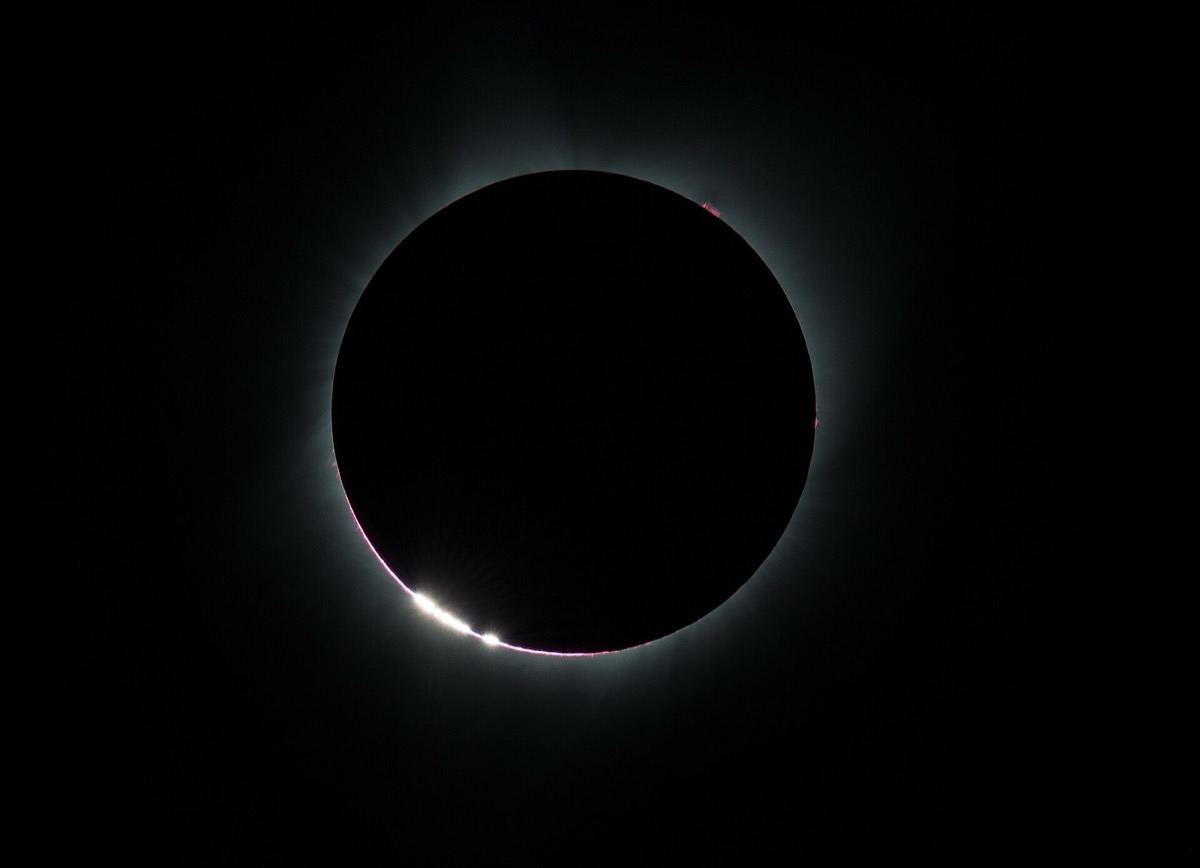
The Sun is about 400 times bigger than the Moon, and also about 400 times farther away, so the two look nearly the same size in the sky.
4. The Moon is drifting away
The Moon gets about an inch farther from Earth every year.
5. Myth: the dark side of the Moon
Earth and the Moon are tidally locked, so you always see the same side. But the far side isn't dark: at new moon, when the side facing you is unlit, the far side is in full sunlight.
6. Myth: summer comes when Earth is closest to the Sun
Earth is closest to the Sun in January and farthest in July. The seasons come from the tilt of Earth's axis, 23.4 degrees.
The planets
7. Venus is hotter than Mercury
Venus is farther from the Sun than Mercury, yet its surface is about 872 °F (467 °C), the hottest of any planet.
8. Venus spins backward, and slower than it orbits
Venus takes 243 Earth days to turn once on its axis, longer than its year of 225 Earth days. It also spins the opposite way to Earth, so the Sun rises in the west and sets in the east.
9. A day on Mercury lasts two of its years
Mercury circles the Sun every 88 Earth days, but one full day and night there takes 176 Earth days, just over two Mercury years.
10. Mars is rusty, with a record volcano
Mars looks red because iron in its rocks has rusted. It also has the largest volcano in the solar system, Olympus Mons, whose base covers an area as large as Arizona.
11. Jupiter has the shortest day
If Jupiter were a hollow shell, 1,000 Earths could fit inside, yet it spins once in about 9.9 hours, the shortest day in the solar system. Its Great Red Spot is a storm bigger than Earth that has raged for hundreds of years.
12. Saturn would float
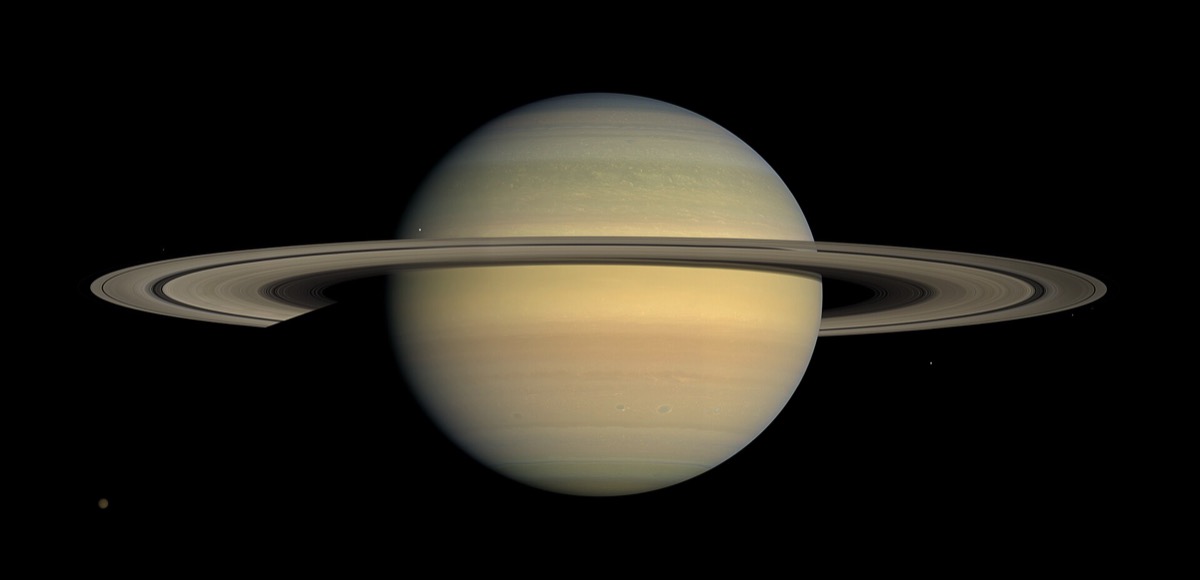
Saturn is the only planet with an average density less than water's, so it could float in a bathtub, if one that big existed. Its main rings, billions of chunks of ice and rock, are typically only about 30 feet (10 meters) tall.
13. Uranus rolls on its side
Uranus is tilted 97.77 degrees, so it spins nearly on its side. For nearly a quarter of its 84-year orbit, the Sun shines directly over one pole, and the other half of the planet has a dark winter 21 years long.
14. Neptune was found with math
Neptune, found in 1846, was the first planet located by mathematical prediction rather than by watching the sky. It takes about 165 Earth years to circle the Sun, so it finished its first orbit since its discovery in 2011.
Stars and galaxies
15. Most stars are too faint to see
Red dwarfs make up around 75% of the Milky Way's stars, but they're too faint to see with the unaided eye. Some may shine for up to about 14 trillion years, far longer than the universe's age so far, about 13.8 billion years.
16. A teaspoon of neutron star weighs a billion tons
A neutron star is typically only the size of a large city, but it's so dense that a teaspoon of it would weigh about a billion tons on Earth.
17. You can see light that's 2.5 million years old
The Andromeda Galaxy, 2.5 million light-years away, is easily visible with the unaided eye from a dark site. The light you see left it 2.5 million years ago.
18. A black hole of 4 million Suns sits at the center of the galaxy
Sagittarius A*, the black hole at the heart of the Milky Way, has a mass of about four million Suns and lies more than 26,000 light-years away. Its first image, made by linking telescopes around the world into one the size of Earth, was published in May 2022.
19. Everything you can see is less than 5% of the universe
Normal matter, the stuff of stars, planets and people, makes up less than 5% of the universe. NASA puts dark matter at about 27% and dark energy at about 68%.
20. Thousands of planets orbit other stars
As of November 5, 2026, NASA's Exoplanet Archive listed 6,464 confirmed planets beyond the solar system, and NASA scientists believe billions exist.
People in space
21. The first human spaceflight lasted 108 minutes
On April 12, 1961, Yuri Gagarin, then 27, orbited Earth once in Vostok 1. The flight lasted 108 minutes, and he didn't land inside the capsule: he ejected and came down by parachute.
22. Twelve people walked on the Moon
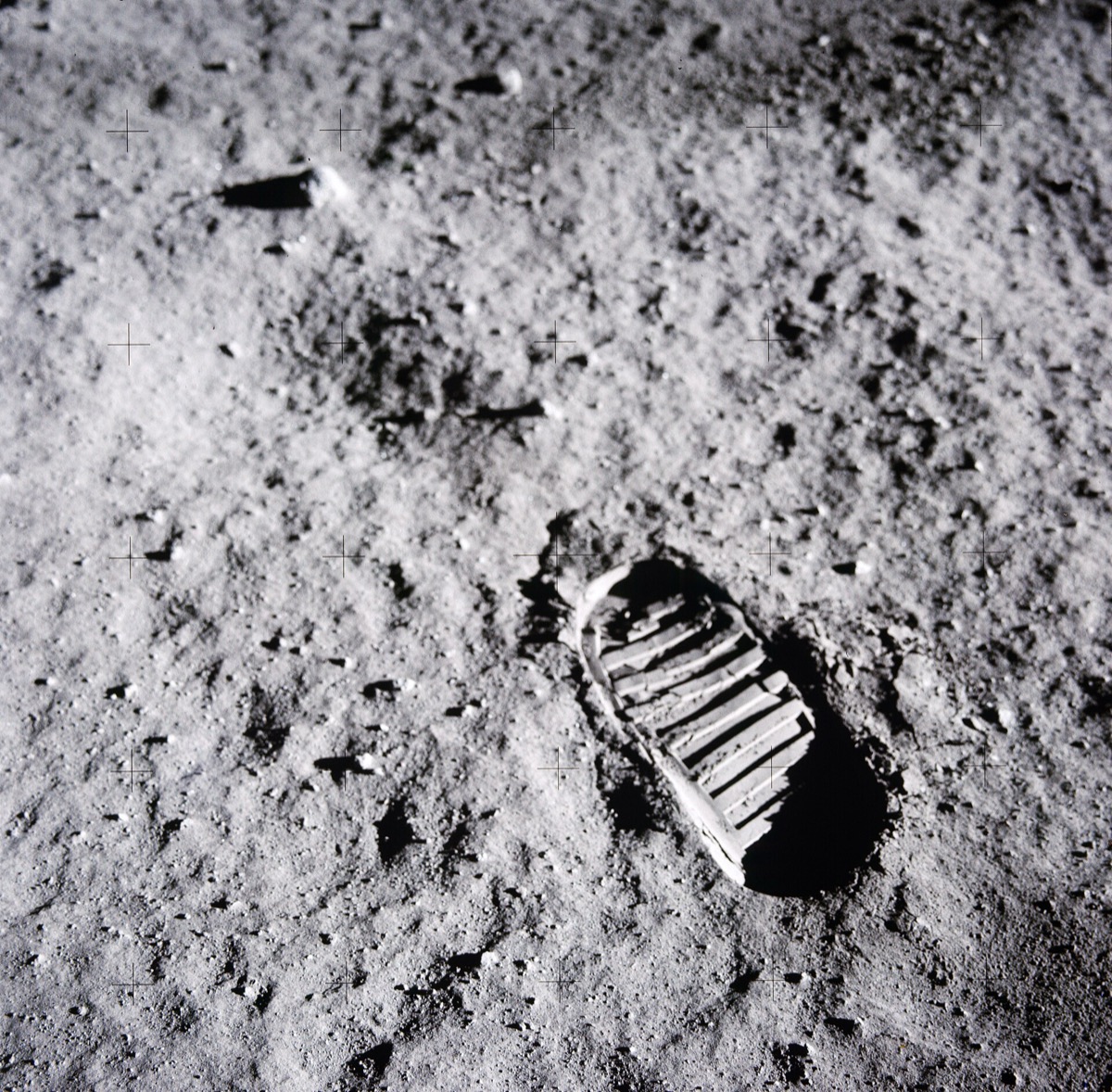
During the Apollo missions of 1969 to 1972, 12 American astronauts walked on the Moon.
23. Artemis II flew farther than anyone before
On April 6, 2026, the Artemis II crew, NASA astronauts Reid Wiseman, Victor Glover and Christina Koch with Canadian astronaut Jeremy Hansen, passed the distance record Apollo 13 set in 1970. They reached 252,756 miles from Earth and splashed down off San Diego on April 10.
24. The space station sees 16 sunrises a day
The International Space Station circles Earth about every 90 minutes at five miles per second, so its crew passes through 16 sunrises and sunsets every 24 hours. People have lived aboard without a break since November 2000.
25. Astronauts grow taller in space
Crew members grow up to 3% taller during long stays on the station, then return to their normal height back on Earth.
26. Myth: you can see the Great Wall of China from space
NASA says the wall is difficult or impossible to see from Earth orbit without high-powered lenses, and it isn't visible from the Moon.
27. Voyager 1 will soon be a light-day away
Voyager 1, launched on September 5, 1977, is the most distant human-made object and still returns data. On November 18, 2026, it will be one light-day from Earth, the distance light travels in 24 hours: about 16 billion miles.
A few for kids
28. You'd weigh much less on the Moon
Gravity on the Moon is one-sixth of Earth's, so a kid who weighs 60 pounds at home would weigh 10 pounds there.
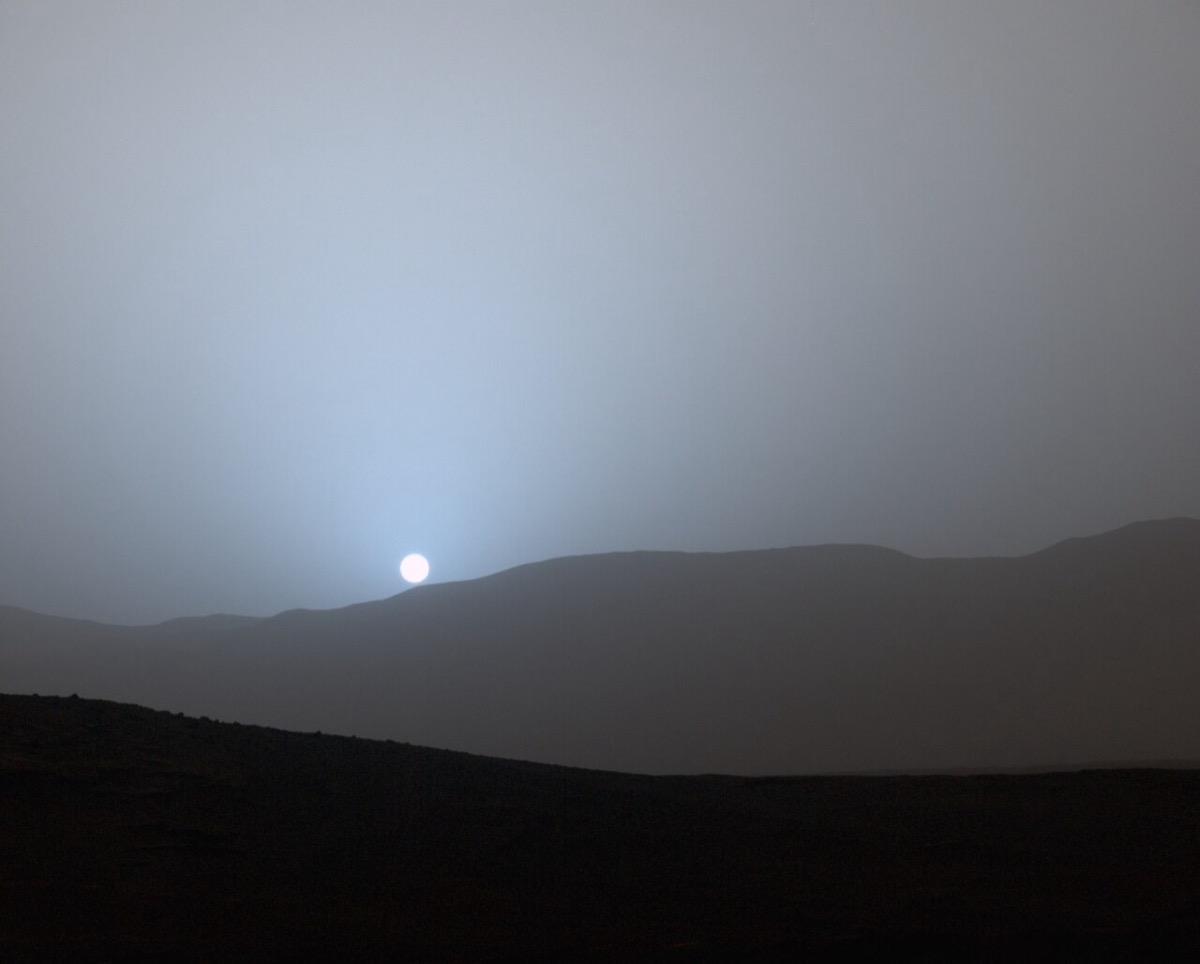
29. Sunsets on Mars are blue
Tiny dust in the Martian air lets blue light through more easily than yellow and red, so the sky around the setting Sun glows blue. NASA's Curiosity rover saw its first color sunset on April 15, 2015.
30. If Earth were a grape, Jupiter would be a basketball
If Earth were the size of a grape, Jupiter would be about as big as a basketball. And if Earth were a nickel, the Moon would be about as big as a coffee bean.
Frequently asked questions
How many planets are in the solar system?
Eight: Mercury, Venus, Earth, Mars, Jupiter, Saturn, Uranus and Neptune. On August 24, 2006, the International Astronomical Union defined a planet and made Pluto a dwarf planet.
What is the hottest planet?
Venus, at about 872 °F (467 °C) at the surface, even though Mercury is closer to the Sun.
How far away is the Moon?
An average of 238,855 miles (384,400 kilometers). Light covers that distance in about 1.3 seconds.
Start Smarty Pants
Facts and clever insights to casually impress people.
Psst is invite-only. Sign up with code SMARTYPANTS
Scan with your iPhone / Download Psst
Psst is invite-only. Sign up with code SMARTYPANTS
Sources
- Sun: Facts (NASA Science)
- Voyager 1: What Is a Light-Day? (NASA Science)
- Time Travel: Observing Cosmic History (NASA Hubble)
- Why Do Eclipses Happen? (NASA Science)
- Earth's Moon: Facts (NASA Science)
- What Causes the Seasons? (NASA Space Place)
- Earth: Facts (NASA Science)
- Venus: Facts (NASA Science)
- Mercury: Facts (NASA Science)
- Mars: Facts (NASA Science)
- Jupiter: Facts (NASA Science)
- Saturn: Facts (NASA Science)
- Uranus: Facts (NASA Science)
- Neptune: Facts (NASA Science)
- Star Types (NASA Science)
- Universe Overview (NASA Science)
- Building Blocks (NASA Science)
- NASA's NuSTAR Mission Celebrates 10 Years Studying the X-Ray Universe (NASA JPL, 2022)
- Messier 31 (The Andromeda Galaxy) (NASA Hubble)
- Telescopes Get Extraordinary View of Milky Way's Black Hole (NASA JPL)
- First Sagittarius A* Event Horizon Telescope Results. I. (Event Horizon Telescope Collaboration, The Astrophysical Journal Letters, 2022)
- Exoplanets (NASA Science)
- NASA Exoplanet Archive (Caltech/IPAC)
- "I see Earth! It is so beautiful!" (ESA, 2011)
- April 1961: First Human Entered Space (NASA)
- Moon Exploration (NASA Science)
- NASA's Artemis II Crew Eclipses Record for Farthest Human Spaceflight (NASA, April 6, 2026)
- NASA Welcomes Record-Setting Artemis II Moonfarers Back to Earth (NASA, April 10, 2026)
- Space Station Facts and Figures (NASA)
- International Space Station (NASA)
- Spinal Ultrasound Investigation (NASA)
- Great Wall (NASA)
- Sunset in Mars' Gale Crater (NASA Photojournal)
- IAU 2006 General Assembly: Result of the IAU Resolution votes (International Astronomical Union)