5-minute workouts you can do anywhere, no equipment needed
Five no-equipment routines that take five minutes each, from a wake-up stretch to squats, stairs and a hotel-room circuit, and why short sessions count.
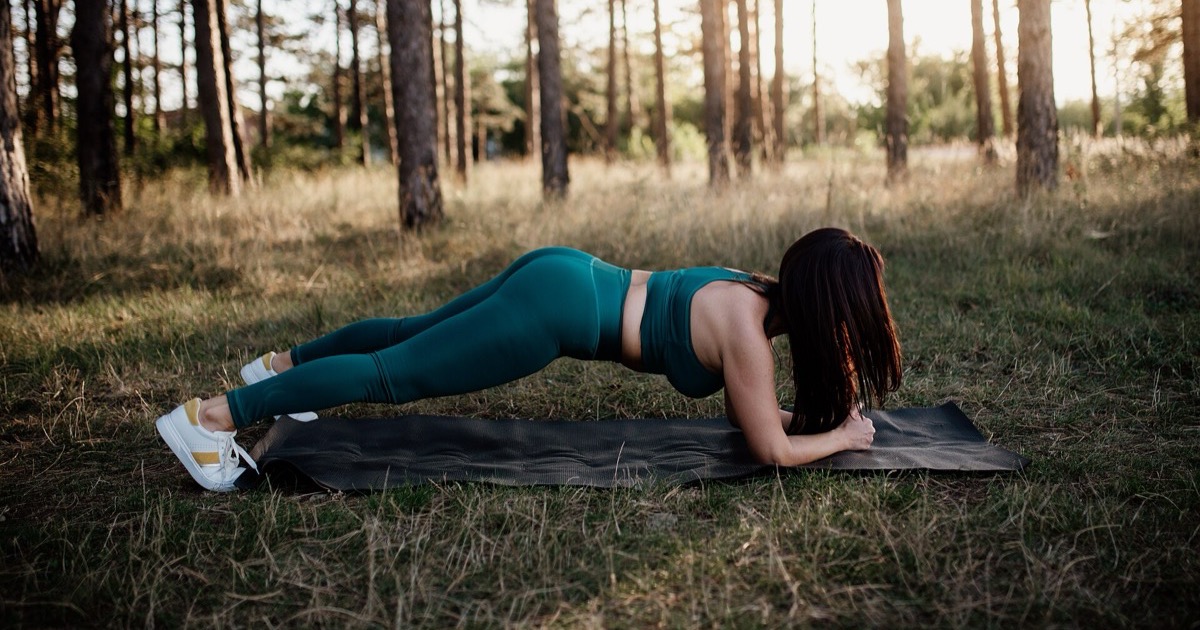
A five-minute workout needs no equipment: pick one of the five routines below, set a timer and move from one exercise to the next. There's a wake-up stretch, a desk break, a strength five with squats, push-ups and lunges, a cardio five on stairs or with jumping jacks, and a hotel-room five. Short sessions count: the 2018 U.S. Physical Activity Guidelines dropped the old rule that activity had to come in bouts of at least 10 minutes.
Why five minutes counts
The first U.S. Physical Activity Guidelines, in 2008, recommended moderate-to-vigorous activity in bouts of 10 minutes or more, because there wasn't enough evidence that shorter bouts helped. The second edition, published by the U.S. Department of Health and Human Services in 2018, lists among its changes the "elimination of the requirement for physical activity of adults to occur in bouts of at least 10 minutes." Its advisory committee concluded that bouts of any length contribute to the health benefits; even climbing a few flights of stairs counts.
The weekly target for adults is at least 150 minutes of moderate or 75 minutes of vigorous aerobic activity, plus muscle-strengthening for all the major muscle groups on 2 or more days. Stretching alone counts toward neither, but for inactive people, swapping sitting for light activity is a good first step.
Two studies of short bursts:
- Bursts in daily life. A 2022 Nature Medicine study followed 25,241 UK Biobank adults, mean age 61.8, who reported no leisure-time exercise and wore wrist activity trackers. Over an average of 6.9 years, those at the median of three vigorous bursts a day, each lasting 1 or 2 minutes, had a 38% to 40% lower risk of death from any cause and from cancer, and a 48% to 49% lower risk of death from cardiovascular disease, than those with none. It's observational: a link, not proof of cause.
- Stair "snacks." In a 2019 randomized trial, 12 sedentary young adults vigorously climbed a 60-step, three-flight stairwell three times a day, three days a week for six weeks, while 12 others didn't train. The climbers' peak oxygen uptake, a measure of cardiorespiratory fitness, was higher afterward, though the authors called the increase modest.
Before you start
- Stop a set when your form slips, as Mayo Clinic advises for squats and lunges.
- Use a stable chair without wheels or arms for chair moves, the NHS says.
If you have a chronic condition or symptoms such as chest pain, dizziness or joint pain, check with your doctor first.
1. A wake-up mobility five
Gentle moves, most of them from the NHS's flexibility and sitting exercises. Don't bounce, and expect tension, not pain, as Mayo Clinic advises for stretching.
- March in place, 1 minute, swinging your arms.
- Neck rotations, 45 seconds. Sitting upright, slowly turn your head toward one shoulder and hold 5 seconds. Three each side.
- Sideways bends, 45 seconds. Standing, slide one arm down your side and hold 2 seconds. Three each side.
- Chest stretch, 1 minute. Sitting upright, pull your shoulders back and down, arms out to the sides, and push your chest forward and up. Hold 5 to 10 seconds, five times.
- Upper-body twist, 1 minute. Sitting, arms crossed with hands on your shoulders, turn your upper body without moving your hips. Hold 5 seconds, five times each side.
- Calf stretch, 30 seconds. Hands on a wall, step one leg back at least a foot, straight with the heel down. Three each side.
2. A desk-break five
The guidelines' first advice for adults is to move more and sit less throughout the day.
- Sit-to-stand, 1 minute. From the front of a chair, lean slightly forward and stand up slowly using your legs, not your arms, then sit down slowly. The slower, the better, the NHS says.
- Calf raises, 1 minute. Holding the chair back, slowly lift both heels as far as is comfortable.
- Hip marching, 1 minute. Sitting upright, lift one knee as far as is comfortable, lower it with control and switch.
- Ankle stretch, 1 minute. Seated, straighten one leg off the floor and point your toes away, then back. Two sets of five each foot.
- Stairs or a brisk walk, 1 minute, to finish.
3. A strength five: squats, push-ups and lunges
This uses Harvard Health's five-in-five format: each move for 20 seconds, rest 10, repeat. That's a minute a move; repeat one for the fifth minute.
- Squats. Feet slightly wider than shoulder-width, toes ahead, bend at the hips, knees and ankles until your knees reach 90 degrees, or as low as you can. Keep your back neutral and your knees centered over your feet (Mayo Clinic).
- Push-ups. Hands under your shoulders, lower until your chest is just above the floor without letting your hips drop, the cues Mayo Clinic gives for a push-up on a stair. Harvard suggests your knees or a wall if that's too hard.
- Lunges. Step forward and lower until your front knee reaches about 90 degrees, then step back and switch legs. Keep that knee over your foot, not past your toes (Mayo Clinic).
- Plank. Keep a straight back, and don't raise or dip your hips (Harvard).
4. A cardio five with stairs or jumping jacks
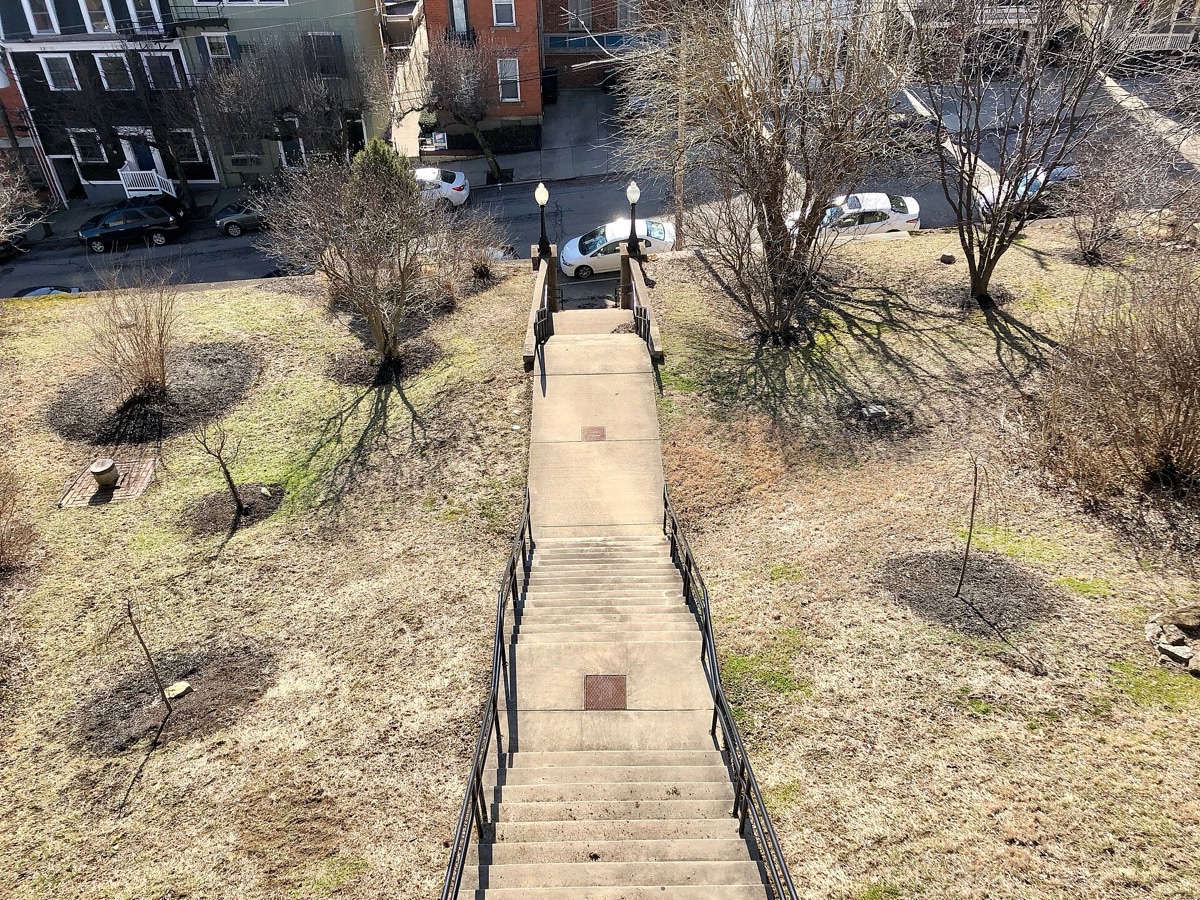
With stairs:
- Minute 1: walk up and down a flight at an easy pace.
- Minutes 2 to 4: climb briskly, walk down easily, and repeat. Brisk means you can say only a few words without pausing for breath, the guidelines' talk test for vigorous effort.
- Minute 5: walk up and down slowly.
Without stairs:
- Minute 1: march in place.
- Minutes 2 to 4: 30 seconds of jumping jacks, then 30 seconds of brisk marching, three times. Harvard Health says jumping jacks raise your heart rate and build lower-body strength.
- Minute 5: march slowly.
Mayo Clinic says to be steady on your feet before any stair exercise: if you can't stand on one leg for 45 seconds without holding on, some may not be safe for you. If jumping bothers your joints, march instead. If you've been inactive, the guidelines suggest starting at a moderate effort, where you can still talk.
5. A hotel-room five
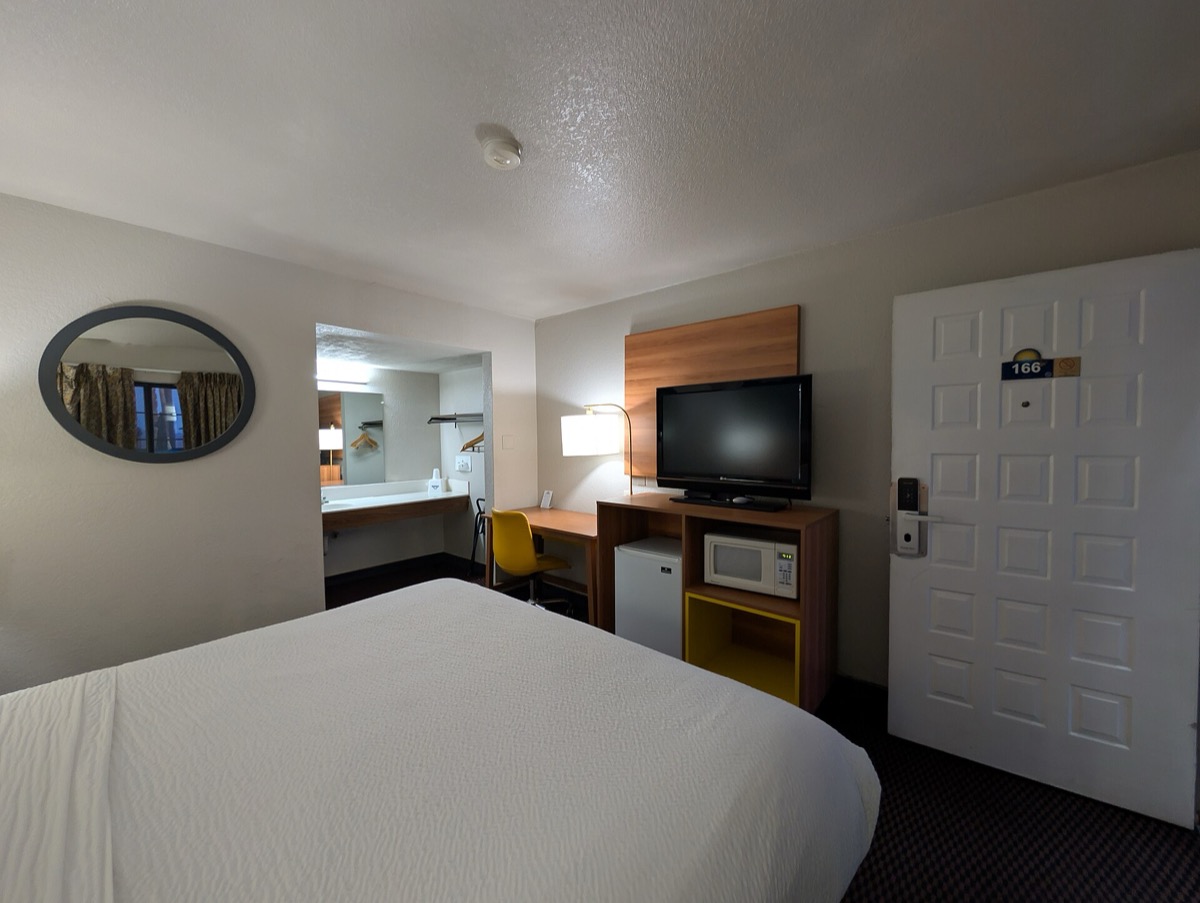
The floor beside the bed is enough. One minute each:
- Squats, as in the strength five.
- Wall push-ups. Stand an arm's length from a wall, hands flat at chest level, elbows close to your sides. Bend your arms to bring your body toward the wall, then push back slowly (NHS).
- Bridges. Lie on your back with knees bent and raise your hips until they line up with your knees and shoulders. Hold for three deep breaths (Mayo Clinic).
- Bird dog. On hands and knees, reach one arm ahead and hold for three deep breaths, then the other arm, then each leg (Mayo Clinic).
- Side plank, 30 seconds a side. On your forearm, shoulder above your elbow, keep your shoulders, hips and knees in a straight line (Mayo Clinic).
How to make them easier or harder
Easier: push-ups against a wall, then on your knees; the NHS mini-squat, holding a chair back and bending only as far as is comfortable; a plank on your knees, as Harvard suggests.
Harder: Harvard's challenge version, each move once for 50 seconds with 10 seconds of rest; Mayo Clinic's harder bird dog, raising the opposite arm and leg together, and side plank, balanced on your hand with your hips raised.
Build up gradually. The guidelines say to add minutes and days first, then intensity, and that a small step up with time to adapt and recover lowers the risk of injury.
Frequently asked questions
Does a 5-minute workout count?
Yes. Since 2018, the U.S. guidelines say moderate-to-vigorous activity of any duration counts toward the weekly targets.
How many 5-minute workouts do I need a day?
The baseline is 150 minutes of moderate or 75 minutes of vigorous activity a week: thirty moderate fives, about four a day, or fifteen vigorous ones, about two a day, plus strength work on 2 or more days.
Can a 5-minute workout build strength?
It can count toward the strength target. The guidelines set no minimum time: work the legs, hips, back, chest, abdomen, shoulders and arms until another repetition would be hard, on at least 2 days a week.
Start Saitama Challenge
Quick sets of push-ups, sit-ups and squats, plus a run. Log them anywhere and climb the power levels to Saitama.
Psst is invite-only. Sign up with code SAITAMA
Scan with your iPhone / Download Psst
Psst is invite-only. Sign up with code SAITAMA
Sources
- Physical Activity Guidelines for Americans, 2nd edition (U.S. Department of Health and Human Services, 2018)
- Association of wearable device-measured vigorous intermittent lifestyle physical activity with mortality (Stamatakis and colleagues, Nature Medicine, 2022)
- Do stair climbing exercise "snacks" improve cardiorespiratory fitness? (Jenkins and colleagues, Applied Physiology, Nutrition, and Metabolism, 2019)
- 3 easy ways to get active, right now (Harvard Health Publishing)
- Flexibility exercises (NHS)
- Sitting exercises (NHS)
- Strength exercises (NHS)
- Stretching: Focus on flexibility (Mayo Clinic)
- Video: Squat exercise (Mayo Clinic)
- Video: Lunge exercise (Mayo Clinic)
- Exercises to improve your core strength (Mayo Clinic)
- Mayo Clinic Q and A: 5 stair exercises to do at home (Mayo Clinic News Network)