100 push-ups a day for a month: what to expect
What 100 push-ups a day for 30 days feels like in the first days, in week two and at the end, how to split the reps, and when to stop.
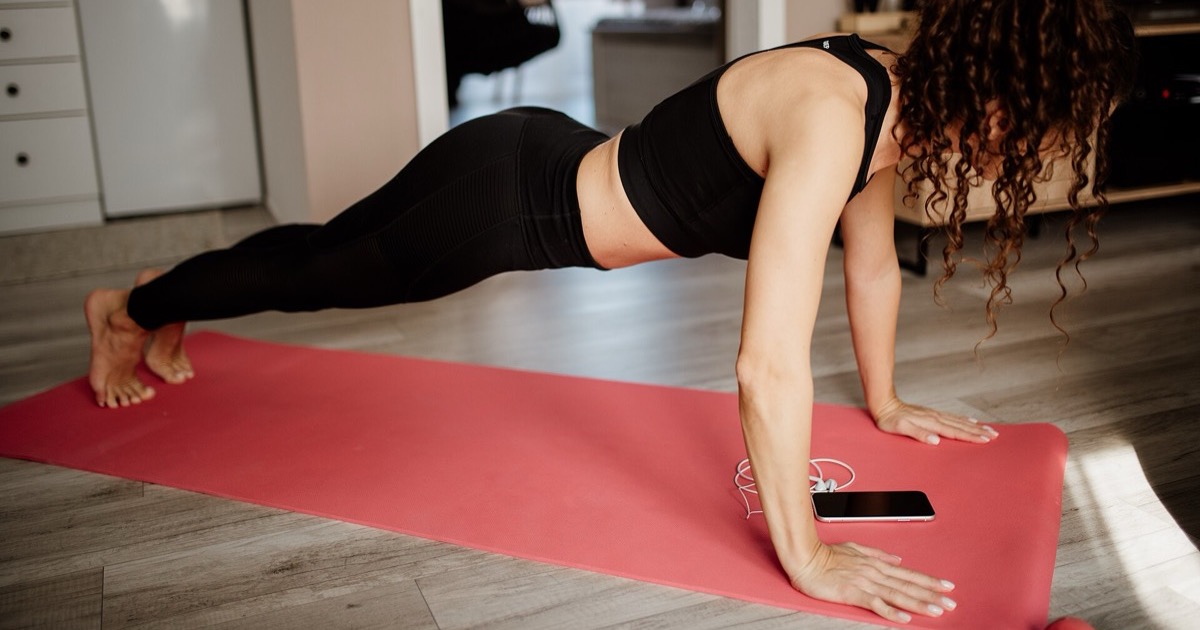
Expect the first few days of 100 push-ups a day to be the hardest, with soreness in your chest, shoulders and arms peaking a day or two after you start. By week two the same work leaves you less sore and the sets feel easier. By the end of the month you'll likely do more push-ups in a row without looking very different: in short studies, push-up training made people stronger before it made muscles measurably bigger. Split the 100 into small sets, use an easier version when your form breaks, and stop for sharp or joint pain, chest pain or dark urine.
Before you start: how much is 100 a day?
Push-ups primarily work the chest, shoulders and upper arms, the U.S. physical activity guidelines note. The CDC asks adults for muscle-strengthening on 2 or more days a week that works all the major muscle groups, including the legs, hips, back and abdomen. The challenge covers part of that list, every day.
Most advice builds in rest. The American College of Sports Medicine (ACSM) recommends training 2 to 3 days a week for beginners and 4 to 5 for people with years of training behind them. An exercise physiologist at the Hospital for Special Surgery (HSS) advises against doing push-ups every day, because your body needs rest to recover and get stronger.
The U.S. guidelines add that less fit adults face a higher risk of injury, and older adults appear to need 2 to 4 weeks to adapt to a new level. A month with rest days, or a smaller daily number, still counts.
If you have a joint problem, a heart condition or another health condition, check with your doctor before you start.
How to split the 100
Find your number first. Harvard Health suggests doing as many push-ups as you can while keeping good form, and says it could be 10, five or even two.
Then pick a set size below that number and repeat it through the day: ten sets of 10, five sets of 20 or twenty sets of 5. Later sets feel harder, so when one breaks down, end it and add a small set later. You don't need all 100 at once.
- Warm up. The U.S. guidelines say a warm-up for strength work commonly means doing the exercises with lighter weight, so start with a few wall or counter push-ups.
- Slow down. Harvard Health suggests two seconds down and one second up.
- Count only good reps. A Harvard-affiliated athletic trainer says five good push-ups are better than ten poor ones.
Form that holds up for 100 reps
Harvard Health's push-up:
- Start in a full plank, arms straight, palms flat just below shoulder level, feet together or about 12 inches apart.
- Keep your back straight and your weight evenly distributed.
- Look down and lower yourself until your elbows reach 90 degrees, then push back up.
To check your depth, roll a towel to about the height of your fist and put it under your forehead. Lower until your forehead touches it.
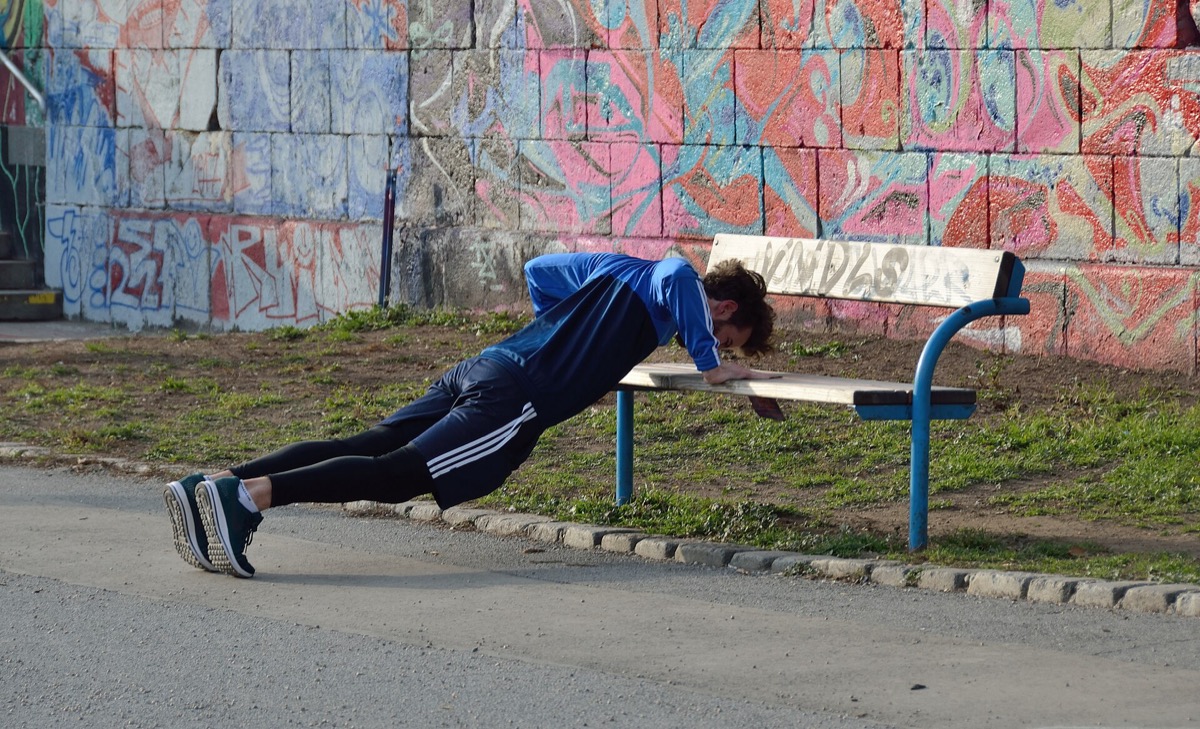
When full push-ups stop holding up, switch to knee push-ups or incline push-ups, with your hands on a counter or wall and your body leaning at about 45 degrees. Harvard Health puts these versions at about 36% to 45% of your body weight, against 50% to 75% for a regular push-up, and notes that the incline version places less weight on the wrists and shoulders.
Days 1 to 3: sore muscles
Harvard Health says delayed-onset muscle soreness is a normal response to working your muscles. It usually peaks 24 to 48 hours after a workout, then eases and disappears in another day or so, so day 2 or 3 may feel worse than day 1.
A 2003 review in Sports Medicine explains why it hits now. Soreness is common when people first take up a new kind of activity, and eccentric, or muscle-lengthening, actions such as the lowering half of a push-up cause small muscle injuries more often than other muscle actions. Expect it where the HSS physiologist says push-ups work: the chest, shoulders, serratus anterior and triceps.
The review suggests that people who train daily cut back for 1 to 2 days after exercise that leaves them very sore, and build up a new exercise over 1 or 2 weeks. Harvard Health agrees: if you're really sore, cut back on reps. You can reach 100 a day over your first week or two instead of on day one.
Week two: less soreness, easier sets
One bout of muscle-damaging exercise makes the muscle less vulnerable to the next, an adaptation called the repeated bout effect. A 2023 meta-analysis of 20 studies found soreness and a blood marker of muscle damage significantly lower 24 and 48 hours after a second bout of multi-joint exercise than after the first.
Sets also get easier as your nervous system adapts: a 2006 review links early strength gains to greater activation of the muscles by the nervous system, and notes that strength can rise without noticeable muscle growth.
Watch for pain that doesn't fade like soreness. An ache in a wrist, elbow or shoulder that builds day after day is different: the U.S. guidelines warn that doing too much of one kind of activity can cause overuse injuries.
The end of the month: what changes
Expect more push-ups per set, not a new body:
- Four weeks, three days a week. In a 2018 study, 14 moderately trained men did progressively harder push-ups. Their bench press maximum and push-up level rose significantly, but their muscle thickness didn't change significantly.
- Four weeks, every day. In a 2025 study, 22 sedentary adults aged 32 to 69 did one slow set of 10 wall push-ups daily, with three other moves, moving to a harder version once 10 felt easy two sessions in a row. Their push-up scores improved significantly, and by the end nine had reached knee push-ups and three full push-ups. Body composition didn't change significantly.
- Eight weeks, twice a week. In a 2017 study of young men, push-ups increased the thickness of the triceps and chest muscles.
In these studies, measurable muscle growth took longer than a month, and in the study that found it, it came from two sessions a week, not seven. After the month, the U.S. guidelines still apply: strength work on at least 2 days a week for all the major muscle groups, and variety to lower the risk of overuse injury.
When to stop
Stop and get advice for any of these:
- Sudden, sharp or long-lasting pain. Harvard Health says to check with your doctor.
- Chest pain, shortness of breath, lightheadedness or joint pain. These are Harvard Health's four red flags: stop and call a doctor if any comes on during activity.
- Dark, red or cola-colored urine, or muscles that are weak, stiff and tender. MedlinePlus lists these among the symptoms of rhabdomyolysis, in which damaged muscle releases a protein that can harm the kidneys, and names severe exertion such as calisthenics as one cause. Contact your provider if you have them.
Push-ups alone can cause it. In a 2017 case report, a 15-year-old who did 50 push-ups for the first time came to doctors six days later with swelling in both upper arms. She was treated with rest and fluids, and the swelling improved after 7 days.
Frequently asked questions
Will 100 push-ups a day build muscle?
Probably not much in one month. In a 4-week study, push-up training raised strength without significantly changing muscle thickness; in an 8-week study, push-ups twice a week thickened the triceps and chest.
Is it OK to do push-ups every day?
Most guidance builds in rest: ACSM recommends 2 to 3 training days a week for beginners, and an HSS exercise physiologist advises against daily push-ups.
What if I can't do 100 push-ups yet?
Do them as knee or incline push-ups, or set a smaller daily number. In the 2025 study, sedentary adults who began with wall push-ups moved on to harder versions within four weeks, and three reached full push-ups.
Start Saitama Challenge
Quick sets of push-ups, sit-ups and squats, plus a run. Log them anywhere and climb the power levels to Saitama.
Psst is invite-only. Sign up with code SAITAMA
Scan with your iPhone / Download Psst
Psst is invite-only. Sign up with code SAITAMA
Sources
- Adult Activity: An Overview (CDC)
- Physical Activity Guidelines for Americans, 2nd edition (U.S. Department of Health and Human Services)
- ACSM position stand: Progression models in resistance training for healthy adults (Medicine and Science in Sports and Exercise, 2009)
- Should you start doing push-ups every day? And how to get the proper form (Hospital for Special Surgery)
- The rise of push-ups: A classic exercise that can help you get stronger (Harvard Health Publishing)
- Taking the Presidential Physical Fitness Test (Harvard Health Publishing)
- Core workout can cause muscle soreness (Harvard Health Publishing)
- Safe exercise: Know the warning signs of pushing too hard (Harvard Health Publishing)
- Delayed onset muscle soreness: treatment strategies and performance factors (Cheung, Hume and Maxwell, Sports Medicine, 2003)
- Exercise-induced muscle damage in humans (Clarkson and Hubal, American Journal of Physical Medicine and Rehabilitation, 2002)
- The repeated bout effect of multiarticular exercises on muscle damage markers and physical performances (Doma and colleagues, Journal of Strength and Conditioning Research, 2023)
- Neural adaptations to resistive exercise: mechanisms and recommendations for training practices (Gabriel, Kamen and Frost, Sports Medicine, 2006)
- Effect of progressive calisthenic push-up training on muscle strength and thickness (Kotarsky and colleagues, Journal of Strength and Conditioning Research, 2018)
- Effects of a daily, home-based, 5-minute eccentric exercise program on physical fitness, body composition, and health in sedentary individuals (Kirk and colleagues, European Journal of Applied Physiology, 2025)
- Low-load bench press and push-up induce similar muscle hypertrophy and strength gain (Kikuchi and Nakazato, Journal of Exercise Science and Fitness, 2017)
- Rhabdomyolysis (MedlinePlus, U.S. National Library of Medicine)
- Bilateral brachial rhabdomyolysis caused by push-up exercise (Suzuki and colleagues, BMJ Case Reports, 2017)